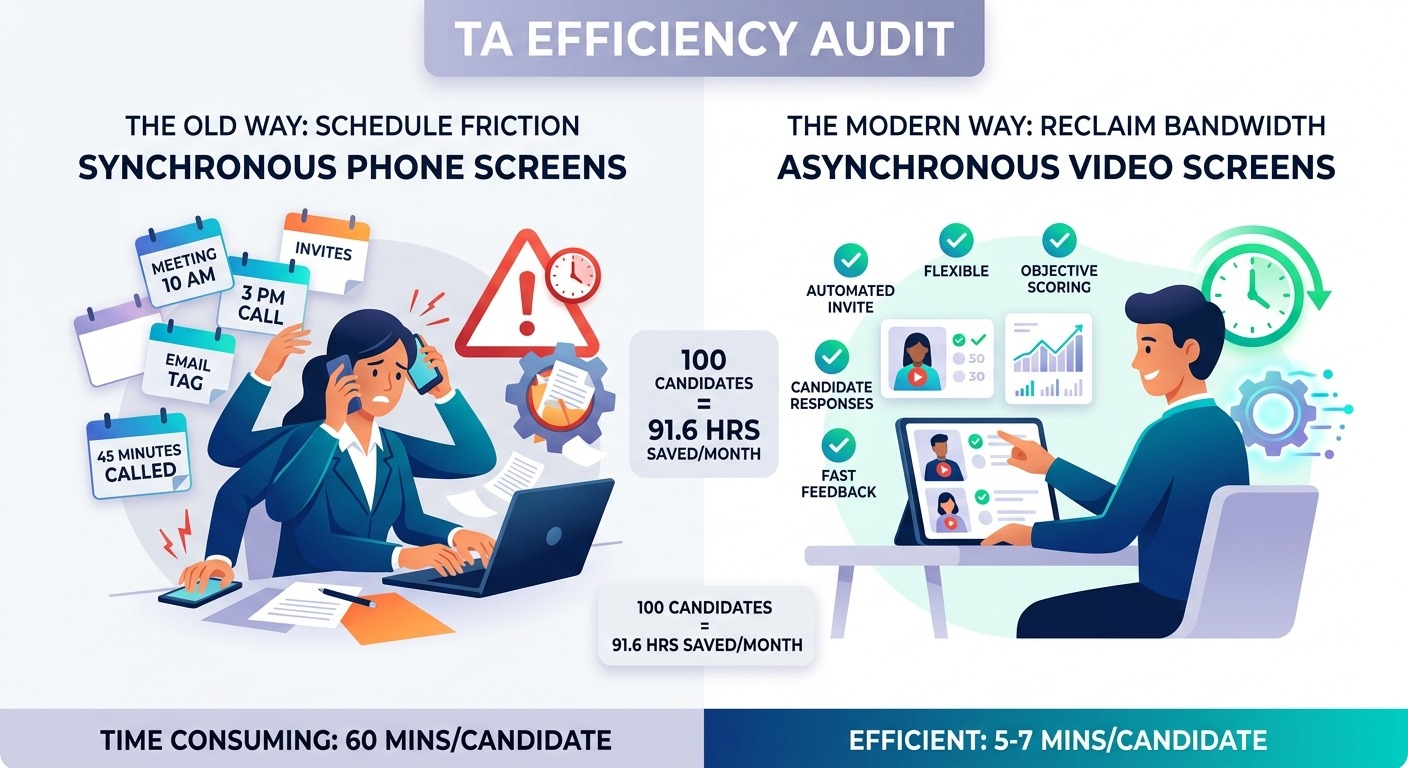
For decades, the standard initial filter in recruitment has been the 30-minute phone screen. Recruiters lock themselves into rigid daily calendar blocks, manually asking the same baseline questions to dozens of candidates: “Tell me about your background,” “What are your salary expectations,” and “Why are you interested in this role?”
While phone screens are familiar, they represent one of the largest hidden operational bottlenecks in Talent Acquisition (TA).
In high-volume environments, relying exclusively on synchronous phone calls consumes hundreds of hours in recruiter bandwidth, delays candidate velocity, and introduces scheduling friction that drives away top-tier talent.
To build a high-velocity hiring machine, HR leaders must conduct an efficiency audit comparing Synchronous Phone Screens against Asynchronous Video Screening.
1. The Resource Audit: Measuring the Hidden Costs
When evaluating phone screens, TA teams often look only at the duration of the call (e.g., 30 minutes). However, the total operational cost includes scheduling coordination, prep time, documentation, and candidate drop-off.
SYNCHRONOUS PHONE SCREEN: COST PER CANDIDATE
- Scheduling & Email Tag: 10 – 15 minutes
- Pre-Call Preparation: 5 minutes
- Live Phone Interview: 30 minutes
- Post-Call Notes & ATS Entry: 10 minutes
TOTAL TIME PER CANDIDATE = 55 – 60 MINUTES
By comparison, asynchronous video screening decentralizes and automates these administrative steps:
====================================================================
ASYNCHRONOUS VIDEO SCREEN: COST PER CANDIDATE
- Automated Invite Trigger: 0 minutes (automated)
- Candidate Recording: Done asynchronously by candidate
- Recruiter Review & Scoring: 5 – 7 minutes
- ATS Scoring Sync: 0 minutes (automated integration)
TOTAL TIME PER CANDIDATE = 5 – 7 MINUTES
The Efficiency Gain: Asynchronous screening reduces recruiter review time by up to 85% per candidate, allowing a single recruiter to process nearly 10 times the applicant volume in the same timeframe.
2. Side-by-Side Operational Comparison
| Operational Metric | Synchronous Phone Screens | Asynchronous Video Screens |
| Scheduling Overhead | High (back-and-forth emails, calendar blocks) | Zero (automated, link-based invitations) |
| Candidate Flexibility | Low (must align with recruiter business hours) | High (completed 24/7 at candidate convenience) |
| Review Consistency | Low (relying on recruiter memory/handwritten notes) | High (recorded responses reviewed against rubrics) |
| Hiring Manager Collaboration | Low (requires lengthy debrief calls) | High (direct sharing of 60-second response clips) |
| Time-to-Shortlist Velocity | 7–14 Business Days | 24–48 Hours |
3. The 3 Myths of Asynchronous Screening
Myth 1: “Async screening creates a cold candidate experience.”
- The Reality: Job seekers—especially top performers balancing existing full-time jobs—frequently cite scheduling phone screens during business hours as a major friction point. Asynchronous screening allows them to interview when they are most prepared and relaxed, without taking time off work.
Myth 2: “Candidates won’t complete video interviews.”
- The Reality: High drop-off in video screening only occurs when the assessment is overly long or unguided. When initial async screens are kept under 10 minutes with clear expectations, completion rates consistently rival or exceed live phone screen show-up rates.
Myth 3: “AI scoring replaces human decision-making.”
- The Reality: AI scoring in async screening serves as a high-speed highlight filter, not a final decision-maker. It surfaces candidate competency signals to recruiters instantly, enabling humans to make faster, more objective shortlisting decisions.
4. Recruiter Capacity Formula: Calculate Your Hours Saved
Use this formula to calculate how many hours your recruitment team can reclaim each month by switching to asynchronous screening:
====================================================================
MONTHLY RECRUITER HOURS SAVED FORMULA
Step 1: Calculate Total Phone Screen Hours
(Monthly Applicants Screened × 55 Minutes) / 60 = Phone Screen Hours
Step 2: Calculate Total Async Review Hours
(Monthly Applicants Screened × 6 Minutes) / 60 = Async Review Hours
Step 3: Calculate Monthly Hours Reclaimed
Phone Screen Hours – Async Review Hours = Hours Reclaimed
====================================================================
EXAMPLE SCENARIO: 100 Candidates Screened / Month
- Live Phone Screen Time: (100 × 55) / 60 = 91.6 Hours
- Async Review Time: (100 × 6) / 60 = 10.0 Hours
TOTAL TIME RECLAIMED = 81.6 RECRUITER HOURS / MONTH
Reclaim Your Team’s Bandwidth
Replacing repetitive phone screens with structured, asynchronous screening isn’t just a technology upgrade—it’s a strategic shift. It frees your TA team from calendar fatigue, compresses your time-to-hire from weeks to days, and gives candidates a flexible, modern way to demonstrate their potential.