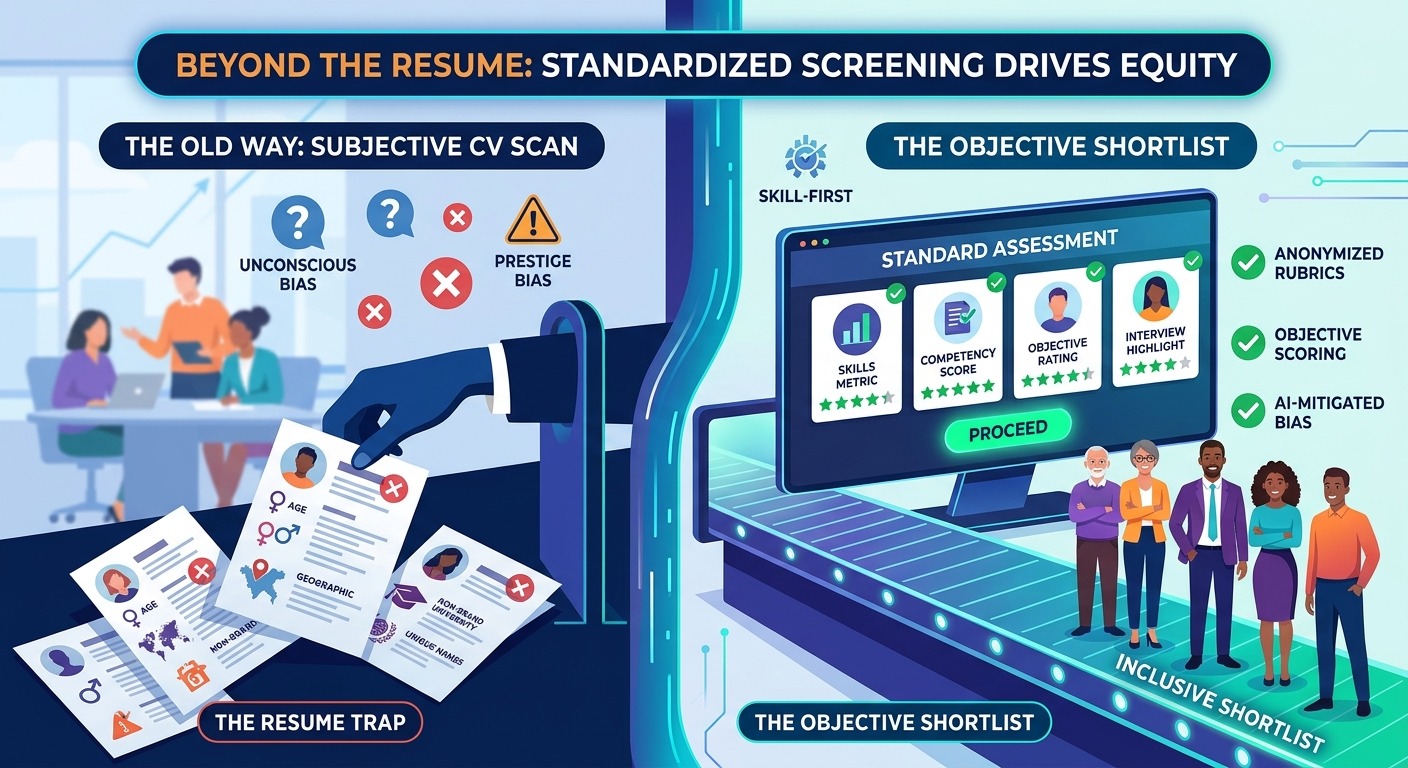
Traditional resume screening is inherently flawed. Studies consistently show that identical resumes with historically marginalized names receive up to 50% fewer callbacks than their counterparts. Beyond names, unconscious biases surrounding physical address, university prestige, and non-linear career gaps frequently lead recruiters to screen out exceptional candidates before ever evaluating their core skills.
For Talent Acquisition (TA) leaders, building an inclusive hiring process isn’t just an ethical imperative—it’s a talent advantage. Relying on static, unstructured resume reviews narrows your candidate pipeline and leads to missed opportunities.
Transitioning to a standardized, bias-mitigated screening workflow allows teams to evaluate candidates on objective competency rather than subjective background signals.
Here is an operational framework for auditing your screening pipeline and implementing a fairer evaluation model.
1. Identifying the 4 Primary Bias Drivers in Resume Screening
Unconscious bias quietly influences early-stage recruitment through four primary triggers:
1. AFFINITY BIAS:
Favoring candidates who attended the same university, worked at
former employers, or share personal background traits with the reviewer.
2. PRESTIGE/NAME-BRAND BIAS:
Equating brand-name previous employers or elite degrees with high
on-the-job competency, while filtering out non-traditional paths.
3. GEOGRAPHIC & DEMOGRAPHIC BIAS:
Unconsciously judging candidate suitability based on zip code,
address proximity, or demographic indicators on a CV.
4. UNSTRUCTURED “GUT FEELING”:
Evaluating candidates without a predefined rubric, leading to
moving goalposts and inconsistent baseline expectations.
2. The 3-Pillar Framework for Bias-Mitigated Screening
To minimize human bias at the top of the funnel, modern TA teams replace unstructured CV scans with a standardized evaluation architecture.
Pillar A: Skill-First Asynchronous Assessment
Instead of asking recruiters to infer capabilities from a list of bullet points on a PDF, present all applicants with identical, job-relevant scenarios via structured asynchronous video or text prompts.
- The Benefit: Every candidate gets the exact same stage, the exact same questions, and the exact same time limit to showcase their skills—eliminating rapport-based advantages present in live phone screens.
Pillar B: Anonymized Evaluation Rubrics
Strip away non-essential demographic identifiers (address, graduation dates, name, personal photos) prior to initial scoring.
- The Benefit: Evaluators focus strictly on the candidate’s structured answers and demonstrated problem-solving skills rather than proxy credentials.
Pillar C: Objective Competency Scoring (AI-Assisted)
Implement AI-driven initial scoring anchored strictly to pre-defined competency criteria rather than open-ended impressions.
- The Benefit: AI models evaluate responses against consistent performance indicators, flagging strong matches based on content quality rather than presentation style or accent.
3. Practical Audit: Evaluator Bias-Mitigation Scorecard
Use this lightweight rubric during quarterly TA compliance reviews to evaluate whether your screening tools and workflows adhere to fair hiring standards:
| Compliance Check | Red Flag (High Bias Risk) | Ideal State (Mitigated Bias) |
| Question Consistency | Recruiters ask different informal questions per call | 100% of candidates answer identical baseline prompts |
| Scoring Criteria | Pass/fail based on “culture fit” or recruiter intuition | Objective 1–5 scoring rubric tied to specific job skills |
| Resume Anonymization | Evaluators see full contact info, locations, and dates | Top-of-funnel evaluation hides non-job-relevant indicators |
| Auditability | No historical record of why a candidate was screened out | Timestamped, rubric-backed scores attached to ATS profile |
4. Diversity Pipeline Impact Calculator
Use this formula to track how standardizing your screening process impacts diversity candidate retention from application to first-round interview:
Step 1: Measure Legacy CV Screening Baseline
(Underrepresented Candidates Advanced to Interview / Total Underrepresented Applicants) * 100
= Legacy Advancement Rate (%)
Step 2: Measure Standardized Async Screening Pipeline
(Underrepresented Candidates Advanced to Interview / Total Underrepresented Applicants) * 100
= Standardized Advancement Rate (%)
Step 3: Calculate Equity Delta
Standardized Advancement Rate (%) – Legacy Advancement Rate (%) = Net Equity Gain
Building a Fairer, Higher-Performing Funnel
Reducing bias in recruitment isn’t about lowering standards—it’s about removing artificial barriers so the best talent naturally rises to the top. By moving beyond static resumes and implementing standardized, objective screening workflows, HR leaders create a faster, more inclusive candidate experience that attracts and retains high-performing talent.